Welcome to our website!
中 | Contact Us Phone:0519-68085059


BLOG
NEWS SHOW
What is the outlook for China’s casting industry? Market output is expected to continue expanding, and the sector is poised to maintain steady, positive growth going forward.
2023-08-15
I. Industrial Chain
A casting is a shaped article produced by various casting methods, in which molten metal is poured, forced, sucked, or otherwise introduced into a pre-prepared mold, and then, after cooling and subsequent processing such as machining and finishing, yields an object with specified shape, dimensions, and properties. The casting industry is a foundational sector of manufacturing and serves as the essential underpinning for innovation and development across a wide range of products and high-end technological equipment, playing an indispensable role in national economic development.
The casting industry has a relatively long industrial value chain, with its primary raw materials consisting of various metallic materials, including pig iron, scrap steel, and non-ferrous metal materials. Pig iron is produced directly by smelting iron ore, whereas scrap steel originates from steel produced through iron-ore smelting and comprises edge and corner scraps, scrapped products, or end-of-life steel components generated during mechanical manufacturing. Because pig iron is a direct-smelting product, its price is higher than that of scrap steel; moreover, scrap steel typically contains a higher level of impurities. Consequently, casting enterprises that rely heavily on scrap steel must possess advanced technical capabilities to ensure effective processing and quality control.
Casting Industry Chain
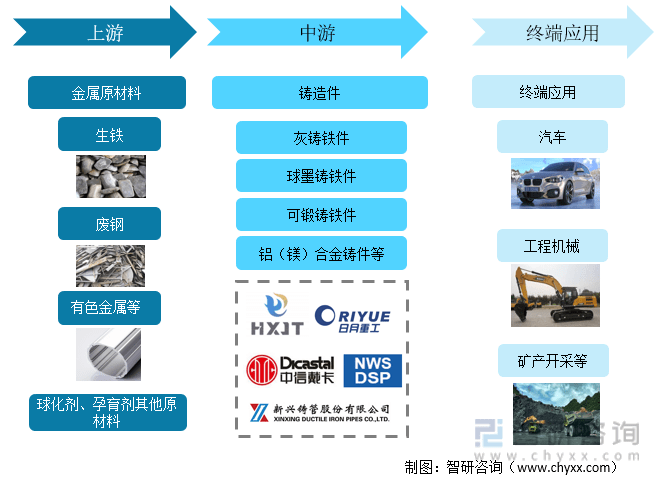
Source: Compiled by Zhiyan Consulting
In 2021, China’s pig iron output reached 869 million tonnes, while scrap steel consumption totaled 226 million tonnes. As pig iron and scrap steel are the primary raw materials for ferrous castings, their prices exert a significant influence on the production costs and product pricing of casting manufacturers. Consequently, many large casting firms include clauses in their contracts with downstream customers that provide for adjustments in response to fluctuations in raw-material prices, thereby helping to mitigate the impact of such price volatility on industry profitability.
China’s Pig Iron Production and Scrap Steel Consumption, 2017–2021
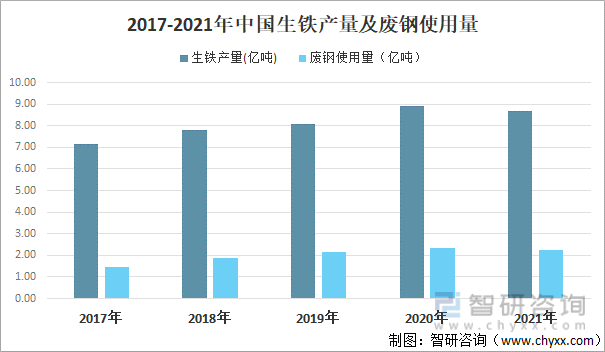
Sources: National Bureau of Statistics, Bureau of International Recycling, and Zhiyan Consulting.
II. Production
1. Global Market
The development of the foundry industry is closely linked to the evolution of global manufacturing. Since the beginning of the 21st century, total global foundry output has generally maintained a growth trend; in 2012, it surpassed 100 million metric tons for the first time and has remained above that level ever since. Prior to 2019, output consistently recorded positive growth or remained flat, but from 2019 to 2020 it declined for two consecutive years. In 2019, declining output in China, India, and many other regions led to a 3.2% drop in global castings production. In 2020, the COVID-19 pandemic caused varying degrees of production halts and shutdowns worldwide, further reducing global castings output—by 13.7% in the United States and by 1.5% in India. In 2021, as COVID-19 outbreaks were brought under control and economies gradually recovered, castings output rebounded to 109 million metric tons.
Global Castings Production, 2013–2021
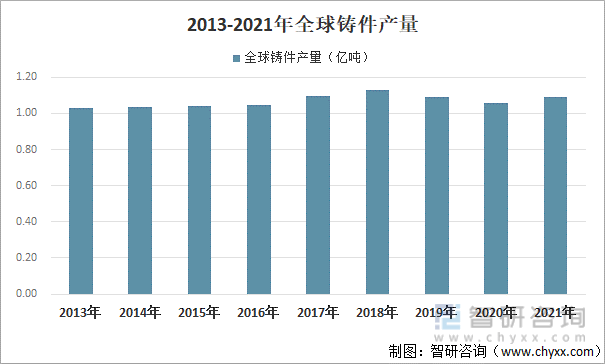
Source: Compiled by the American Foundry Society and Zhiyan Consulting.
From a regional perspective, the share of global casting output attributable to emerging markets has been increasing year by year as these economies rise. In 2020, the top ten regions in terms of global casting production were China, India, the United States, Russia, Germany, Japan, Mexico, South Korea, Turkey, and Brazil, collectively accounting for more than 80% of total global output, with China alone contributing nearly 50%.
Top 10 Regions in Global Casting Production in 2020 (in 10,000 tonnes)
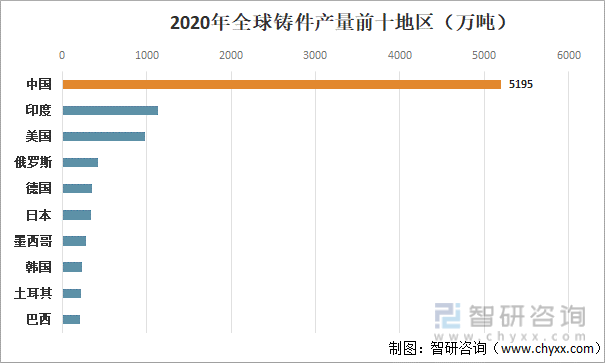
Source: Compiled by the American Foundry Society and Zhiyan Consulting.
2. China’s Production
At the founding of the People’s Republic of China, the country’s industrial base was weak, and the casting industry was largely composed of small, artisanal workshops, with total annual output of castings amounting to only several hundred thousand tons. Following the reform and opening-up, China’s secondary sector entered a period of rapid development, which in turn spurred swift progress in the domestic casting industry. As a foundational sector of manufacturing, the growth of China’s casting industry has also fueled the expansion of the entire manufacturing sector.
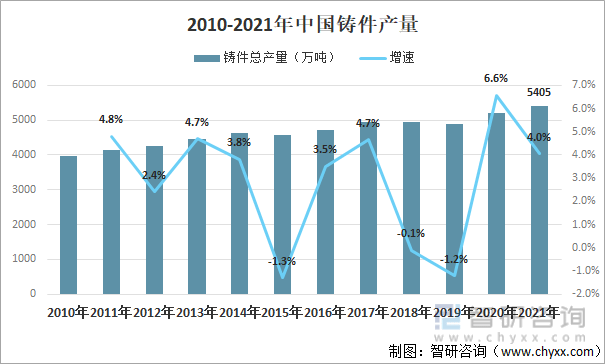
Since the beginning of the 21st century, China’s foundry industry has maintained a steady overall growth trend. In 2000, China surpassed the United States for the first time to become the world’s largest producer of castings, and has since consistently held the top position globally. Since 2010, with the exception of 2015—when output declined due to changes in the macroeconomic environment—and 2018–2019—when it was affected by a downturn in industries such as automotive—annual casting production has recorded positive growth in all other years. In 2020, as China accelerated the resumption of work and production, casting output reached 51.95 million tonnes, further increasing to 54.05 million tonnes in 2021. Although China’s total output far exceeds that of other countries, its average output per enterprise remains lower than in developed nations, and the large number of small foundries continues to weigh down the capacity structure of China’s foundry sector.
China’s Castings Production, 2010–2021
Source: Compiled by the China Foundry Association and Zhiyan Consulting.
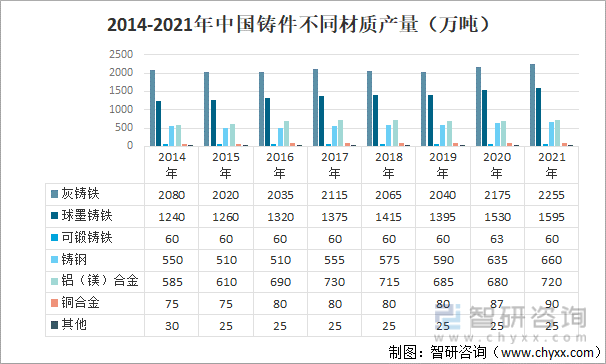
Castings can be broadly classified into two main categories: ferrous castings and nonferrous castings. Based on the specific metal materials used, they are further subdivided into cast iron castings, cast steel castings, and castings made from nonferrous alloys (such as aluminum, magnesium, copper, and zinc). Ferrous casting remains the dominant segment in the foundry industry, accounting for more than 80% of total output. Among these, the share of gray iron castings has declined markedly, dropping from 45.0% in 2014 to 41.7% in 2021; nevertheless, gray cast iron continues to be the most widely used material across all casting applications.
During the period from 2014 to 2021, ductile iron experienced the largest increase in market share, reaching 29.5% in 2021—a rise of 2.7 percentage points compared with 2014. Production grew from 12.4 million tonnes to 15.95 million tonnes, primarily due to ductile iron’s excellent casting performance, relatively low cost, and expanding range of applications, including internal combustion engines, agricultural machinery, wind-turbine castings, and cast pipes and pipe fittings.
Driven by the robust growth of the new-energy vehicle industry and the trend toward vehicle lightweighting, the share of aluminum (and magnesium) alloy production in total output increased by 0.7 percentage points from 2014 to 13.3% in 2021, with total production reaching 7.2 million tonnes.
China’s Castings Production by Material, 2014–2021 (in 10,000 tonnes)
Source: Compiled by the China Foundry Association and Zhiyan Consulting.
Related Report: “2022–2028 China Casting Industry Competitive Landscape and Development Prospects Forecast Report” published by Zhiyan Consulting.
III. Downstream Application Structure
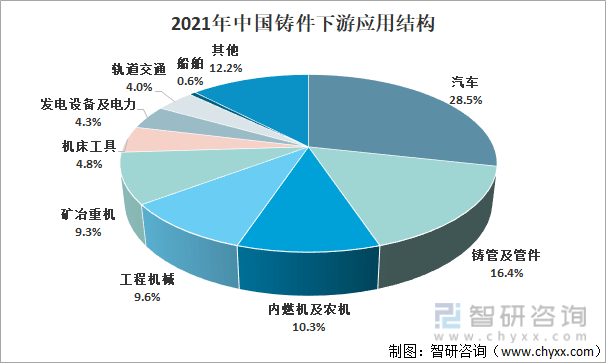
Castings are extensively used across a wide range of manufacturing industries, including automotive, internal combustion engines, mining and metallurgy, construction machinery, power generation, rail transit, and shipbuilding, serving as core components in these sectors and often accounting for a substantial share of the total weight of the finished equipment. From the perspective of downstream applications, the automotive sector has consistently been the largest end-use market for China’s casting industry, with its share fluctuating around 30%; in 2021, it accounted for 28.5%. The next largest segment is cast pipes and pipe fittings, representing 16.4%, followed by internal combustion engines and agricultural machinery at 10.3%.
Downstream Application Structure of China’s Castings in 2021
Source: Compiled by the China Foundry Association and Zhiyan Consulting.
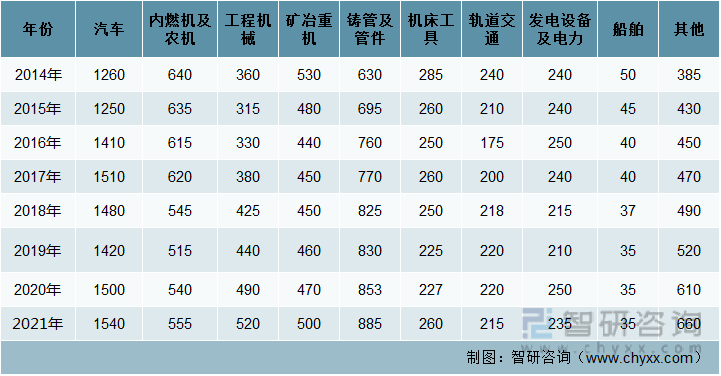
From 2014 to 2021, castings output in the automotive sector remained above 12 million tonnes. During 2018–2019, China’s automotive industry faced sustained macroeconomic headwinds, an early depletion of the effects of the purchase-tax incentive policy, and a decline in export volumes, leading to a continuous drop in production and sales and, consequently, a reduction in demand for castings. In 2020, driven by factors such as the phase-out of National III emission-standard vehicles, stricter overloading enforcement, and increased infrastructure investment, commercial-vehicle production and sales posted substantial year-on-year growth, serving as a key driver of the market’s recovery that year; spurred by this robust expansion in commercial vehicles, automotive-casting output rose by 5.6% in 2020. In 2021, as the automotive market rebounded, castings output further increased to 15.4 million tonnes. In addition, castings output in the internal-combustion-engine, agricultural-machinery, construction-equipment, mining-and-metallurgical heavy-machinery, and cast-pipe-and-fitting sectors each exceeded 5 million tonnes.
Distribution of Downstream Applications of China’s Castings, 2014–2021 (in 10,000 tonnes)
Source: Compiled by the China Foundry Association and Zhiyan Consulting.
As the largest downstream application sector for the casting industry, the automotive industry exerts a significant influence on its performance. In 2021, China’s automobile production and sales reversed three consecutive years of decline and began to recover, with new-energy vehicles emerging as the standout segment. Driven by robust domestic demand and the recovery of international markets as well as the enhanced competitiveness of Chinese brands, China’s automobile exports also achieved record highs. However, in the first half of 2022, outbreaks in Shanghai, Jilin, and other regions severely disrupted the Chinese auto industry, resulting in production and sales volumes of 12.117 million and 12.057 million units, down 3.7% and 6.6% year on year, respectively. With the effective containment of the pandemic, the automotive sector is expected to gradually rebound. According to data from the China Association of Automobile Manufacturers, China’s automobile sales in 2022 are forecast to reach approximately 27 million units, representing a year-on-year increase of around 3%. The favorable outlook for the automotive industry, coupled with steady growth in sectors such as wind power, cast iron pipes, and pipe fittings, will help sustain a generally stable yet improving trend in China’s casting industry.
China’s Automobile Production and Sales from 2016 to the First Half of 2022
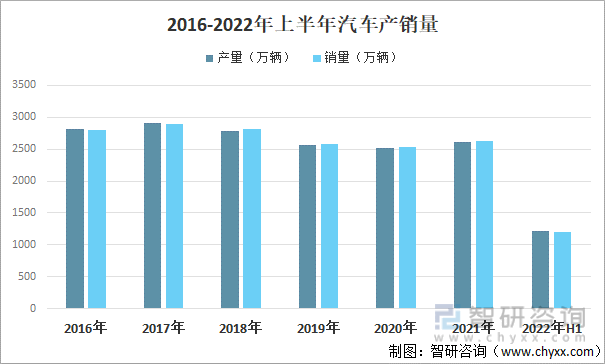
Source: Compiled by the China Association of Automobile Manufacturers and Zhiyan Consulting.
The foregoing data and information are available in the “2022–2028 China Casting Industry Development Trends and Investment Decision-Making Recommendations Report” published by Zhiyan Consulting. Zhiyan Consulting is a comprehensive provider of information and intelligence in China’s industrial consulting sector. The company’s brand philosophy is “Leveraging information to drive industrial development and empower enterprises in their investment decision-making.” It offers professional industry consulting services, including premium industry research reports, customized special studies, monthly thematic reports, feasibility study reports, business plans, and industrial planning. In addition, it provides regular reports—weekly, monthly, quarterly, and annual—as well as tailored data sets, covering policy monitoring, corporate developments, industry statistics, product price trends, an overview of investment and financing activities, and analyses of market opportunities and risks.
Next:


Wonderful waiting for you!
WeChat public account
Or search for “Feather Wing Casting”
Address: No. 55, Chuangye Road, Zhulin Town, Jintan District, Changzhou City, Jiangsu Province
Phone:0519-68085059
Email:1746088625@qq.com
Copyright © 2026 Jiangsu Yuyi Casting Co., Ltd. All Rights Reserved.